Currently there are 12,000,000 to 20,000,000 illegal aliens present in the United States (nothing to do with lesbians).
More: Youtube, Michelle Malkin
 Daily Telegraph, May 2007
 Michael Pascoe, Crikey, May 2007
 Ross Gittins, Sydney Morning Herald, February 2006
 m Gosling, Online Opinion, February 2006
 Expatica News, May 2007
“The texts in Islam distinguish themselves from the texts of other religions by encouraging violence and aggression against people with other religious beliefs to a larger degree. There are also straightforward calls for terror. This has long been a taboo in the research into Islam, but it is a fact that we need to deal with," says Tina Magaard.Moreover, there are hundreds of calls in the Koran for fighting against people of other faiths.
“If it is correct that many Muslims view the Koran as the literal words of God, which cannot be interpreted or rephrased, then we have a problem. It is indisputable that the texts encourage terror and violence. Consequently, it must be reasonable to ask Muslims themselves how they relate to the text, if they read it as it is," says Tina Magaard.More: Fjordman


 The scene was sadly familiar, especially in the strife-torn Middle East. In the shadow of a great mosque, a crowd of 40,000 gathered to bury a victim of political violence—and vent their rage at the authorities. But this was not Iraq or the Palestinian territories. It was downtown Ankara. Nor were the demonstrators angry Islamist fanatics. They were judges, bureaucrats and businessmen, staunch secularists shouting out their loyalty to the state—and denouncing a government they say is taking Turkey down a dangerously Islamic path. "Turkey is secular and will remain secular," they chanted. "Turkey will not become an Iran."
The occasion was the funeral of Judge Mustafa Yucel Ozbilgin, killed by a 28-year-old lawyer who opened fire recently inside Turkey's High Court. The gunman's motives are not yet clear, but the presumption of most in the crowd was that he was a militant Islamist getting revenge for a court ruling last November that upheld restrictions on the wearing of headscarves in and around public schools. "This is an attack on the secular republic," declared President Ahmet Necdet Sezer, who accused Turkey's ruling Justice and Development Party, or AKP, of seeking to "destroy the regime" by undermining the country's strict division between mosque and state ...
Ever since he came to power in a landslide victory in 2002, Erdogan has been trying to roll back Turkey's brand of draconian secularism. His party has appointed religiously minded bureaucrats to senior positions in the Education Ministry; last year it tried (unsuccessfully) to criminalize adultery. The AKP has steadily campaigned to lift the ban on headscarves in schools, universities and government offices, though so far Turkish courts (and even the European Court of Human Rights) have rejected their plea. Most controversially, last month Bulent Arinc, the AKP speaker of Parliament, suggested the time had come to "reconsider the concept of secularism as it is practiced in Turkey"—triggering a storm of protest. Erdogan's Islamism may be mild by Middle Eastern standards, but this month's demonstrations are a clear sign that he may have gone too far. "The so-far silent secularists have now raised their voice," says Professor Nilufer Narli of Istanbul's Bahcesehir University. "This is a massive movement of people from all walks of life."
The government also tried to downplay the more overtly Islamist elements of its program. The headscarf issue is "a problem perhaps for only one and a half percent of the people," according to Deputy Prime Minister Mehmet Ali Sahin, who insists that the government's priority is unemployment and the economy.
... other reforms—chiefly new laws liberalizing the country's antiquated justice system and granting new rights of free speech and religious tolerance to Turkish minorities, including his own Islamist backers ...
In a clumsy attempt to put an AKP loyalist at the helm of one of Turkey's few independent institutions, Erdogan tried to appoint the former head of a Saudi-owned Islamic bank to the post. Eventually the job went to Durmus Yilmaz, an old hand at the Central Bank. But the affair shook businessmen's confidence, and the economy's recent troubles have eroded that trust even more. "The government is paying more attention to installing its own people and following its own religious agenda," complains Mehmet Ali Ince, an importer of copying equipment in Istanbul whose business has been hit by the falling lira ...
Critics of the ruling party fear that if Erdogan were indeed to take the job, the AKP would be emboldened to push through exactly the Islamic policies they're shying away from today—such as scrapping the headscarf ban and ending government control over religious appointments and even the content of sermons.
More: Newsweek
 A background story on why tensions are rising in Turkey between Islamists and secularists ...
 Four of the judges, including Mr Ozbilgin, had voted in February against the promotion of an elementary school teacher who wore a headscarf outside of work. The fifth had voted in favour. The judges' photographs were published by the pro-Islamist Vakit newspaper. The court's decision was criticised by Recep Tayyip Erdogan, the prime minister, whose AK party has roots in political Islam. Mr Erdogan condemned yesterday's shooting.
 According to public polls, the large majority of the Turkish population is not against the wearing of headscarves in public buildings. A political party which would like to soften the bans against headscarves has been in power in Ankara now for four years. The near future does not, however, appear to hold any prospect of liberalization on this matter. The careful efforts by the government to start solving this problem were interrupted from the very beginning by the opposition’s rejection of calls by the ruling adminsitration to work together to soften the headscarf ban, and by the resisitance of the military and a large part of the Turkish media. When in May 2006 a judge was killed most likely as a result of a decision he had made against a headscarved student’s case, the emotions on this matter rose to even greater heights across Turkey. This murder spawned a giant march in Ankara in support of secularity, and many people were reminded of the atmosphere of spring 1997 by the tension in the air. Since that time then, there have been no calm or reasonable debates in Turkey over the headscarf.
 There has been a rush of other books espousing atheism ... Of monotheism, Hitchens writes with trademark floridity, it is "a plagiarism of a plagiarism of a hearsay of a hearsay, of an illusion of an illusion, extending all the way back to a fabrication of a few non-events" ...
More: Sydney Morning Herald, RichardDawkins.net, Google Video
My thoughts ...
Dawkins is stating the obvious by saying that humans are more cultural than rational. Cult-ure is what binds us, the highest human drive - it deserves both respect for the connectedness it brings, and fear for the blind herd mentality. I hope Dawkins uses his brain to go further than just stating the problem, to find some solutions.

THE Government of Saudi Arabia is continuing to fund extremists within the Australian Muslim community. It does this partly through the Saudi embassy in Canberra. It ought to stop. Saudi Arabia is a theocratic monarchy that recognises no distinction within its rule between politics and religion. It adheres to an extremely conservative and paranoid version of Islam known as Wahabism, which it tries to promote throughout the world.
It also has a history of funding terrorists. It was the chief bankroller of the Palestine Liberation Organisation in the 1970s and ‘80s at the height of the PLO’s involvement in global terror. But it would be true to say that, worldwide, the Saudis tend to fund the precursors to terror rather than terror itself. Since the 9/11 attacks in the US, in which the majority of hijackers were Saudis, the Saudi Government, under intense US pressure, has tried to exercise greater care and control over where Saudi money goes.

... tens of millions of dollars of Saudi money had also come into Australia. In the ‘70s, ‘80s and ‘90s, this was fairly open. The Saudis funded mosques, Islamic schools and various special courses. They promoted Wahabi literature widely. All of this material promoted an extreme version of Islam, but in those pre-9/11 days nobody worried.
... in 2004, Saudi officials came to the Department of Foreign Affairs and Trade with their own proposal. They would in future notify the Australian Government of any Saudi funds coming to Australia. DFAT naturally agreed. This agreement is what allows the Saudi embassy occasionally to claim that its activities in Australia are approved by the Australian Government.
But there is every reason to believe this agreement has been almost wholly ineffective. First, it only covers new Saudi money, it doesn’t cover any existing pre-agreement payments the Saudis might be making. Thus, due to the outstanding reporting of Richard Kerbaj in this newspaper, we now know that the Saudi embassy has been paying an annual stipend, alleged to be about $US30,000 ($36,000), to the imam of Canberra’s Abu Bakr Mosque, one Imran Mohammed Swaiti. Kerbaj has also written that Swaiti has preached sermons in Arabic calling for victory to the mujaheddin, including, but not limited to, victory in Iraq and Afghanistan ...
However, the agreement is not working, as the Swaiti case demonstrates. Not only is there the giant loophole of not covering existing arrangements, the agreement also specifically does not cover private donations from Saudis, which they consider to be part of their religious duties.
 More: the Australian, Wahhabism
Click on image to watch video at HotAir ...

 Quote from video ... Onur Oymen of the secularist Republican People’s Party recently denied that the secularist ralliers represented “moderate Islam.” He declared: “You can’t have democracy without secularism. The notion of moderate Islam to check radical Islam is nonsense. This idea being promoted by certain countries should be abandoned.”
More: HotAir, FrontPage Transcript

 Our resistance so far has been the first stage: to know the enemy and to develop a strategy. We are now coming to the end of it. Since 9/11 we have had intellectual warriors who have studied Political Islam, built websites, blogged and written books.
Our military capacities are not in doubt today. It is our moral self-confidenceMore: The Objective Standard, Jihad Watch
that is in question. What was it that stopped us from confronting Iran in 1979,
except a lack of confidence in our own rightness, and an unwillingness to defend
ourselves for our own sakes? Had we removed the Iranian regime in 1979,
thousands of Americans would have been saved, and children across the world
would not have grown up with sword verses rising in their minds as they give
their lives to jihad. Consider the Japanese—and ask whether it would have been
in our interest to have left the regime of 1945 in power, to continue preaching
religious militarism and training kamikaze. The best thing Americans did for
themselves (and, incidentally, the kindest thing for the Japanese) was to burn
that regime to the ground. So it is today. The Islamic State—Totalitarian
Islam—must go. And it is the moral responsibility of every American to demand
it.
Ireland
Muslim Immigration
South Pacific Immigration
 The Courier Mail, May 2007


More: Courier Mail, Winds of Jihad
 MUSLIM leaders in the nation's capital will take out a restraining order against a hardline cleric who is accused of inciting violence and "anti-Western" sentiment among his followers.
 The move by the Islamic society of ACT to ban Sheik Mohammed Swaiti from Canberra's Abu Bakr Mosque comes after a Muslim leader was bashed by a group of the cleric's supporters.
The council's secretary, Kurt Kennedy, yesterday told The Australian he was set upon by nine men aged in their 20s, including Palestinian-born Sheik Swaiti's son, at the mosque's front entrance last Friday.
The bashing followed the council's decision to remove the imam from his position as the mosque's spiritual head. Mr Kennedy had announced Sheik Swaiti would no longer deliver Friday sermons.
Shortly after the announcement Sheik Swaiti stood in front of his worshippers and screamed "I am the imam of the mosque, I will be here until the day I die", Islamic Society of ACT vice-president Mohammed Berjaoui said yesterday.
Mr Kennedy, 35, who was pushed and threatened by Sheik Swaiti's followers inside the mosque following his announcement, was beaten up while waiting for a lift home. He was treated for cuts on his face and head at Canberra Hospital ...


The Islamic council's push to replace Sheik Swaiti with a full-time moderate Turkish-born imam, Yahya Atay, came after The Weekend Australian reported last month that Sheik Swaiti praised mujahideen (Muslim holy warriors) in his sermon ...
Mr Berjaoui accused Sheik Swaiti of preventing Canberra's Muslim community from integrating into the mainstream ...
The tax office, which refused to comment on its inquiry into Sheik Swaiti, is investigating allegations that he failed to declare clerical allowances of up to $US30,000 ($36,000) a year, allegedly paid to him by the Saudi Government's Dawah (donations) Office ...

 UK Telegraph, March 2007
"As a result of it, the country may possibly have reached a tipping point beyond which it can no longer be said to contain a single nation. Should that point have been reached, then, ironically in the course of Britain having become a nation of immigrants, it would have ceased to be a nation.David Davis, the shadow home secretary, said: "This report suggests that the Government's inability to get a grip on immigration or put a limit on numbers entering the UK is destabilising British society. We know that unchecked immigration is putting pressure on housing and local services. Now this report shows that its effects are potentially even more serious."
"Once such a point is reached, political disintegration may be predicted to be not long in following." ...
 The London neighborhood of the author's youth, Finsbury Park, is now one of the breeding grounds for a new phenomenon: the British jihadist. How did a nation move from cricket and fish-and-chips to burkas and shoe-bombers in a single generation?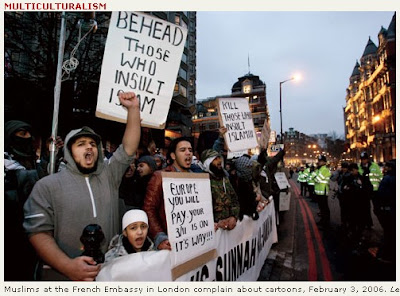
Traditional Islamic law says that Muslims who live in non-Muslim societies must obey the law of the majority. But this does not restrain those who now believe that they can proselytize Islam by force, and need not obey kuffar law in the meantime. I find myself haunted by a challenge that was offered on the BBC by a Muslim activist named Anjem Choudary: a man who has praised the 9/11 murders as "magnificent" and proclaimed that "Britain belongs to Allah." When asked if he might prefer to move to a country which practices Shari'a, he replied: "Who says you own Britain anyway?" A question that will have to be answered one way or another.
More: Vanity Fair, Winds of Jihad

